750 Business Words
| www.speakmethod.com |
||
|
750 Business Words |
|
| Return to Main Page |
Perfect Your Pronunciation and Stress with 750 Business Words |
Sign in |
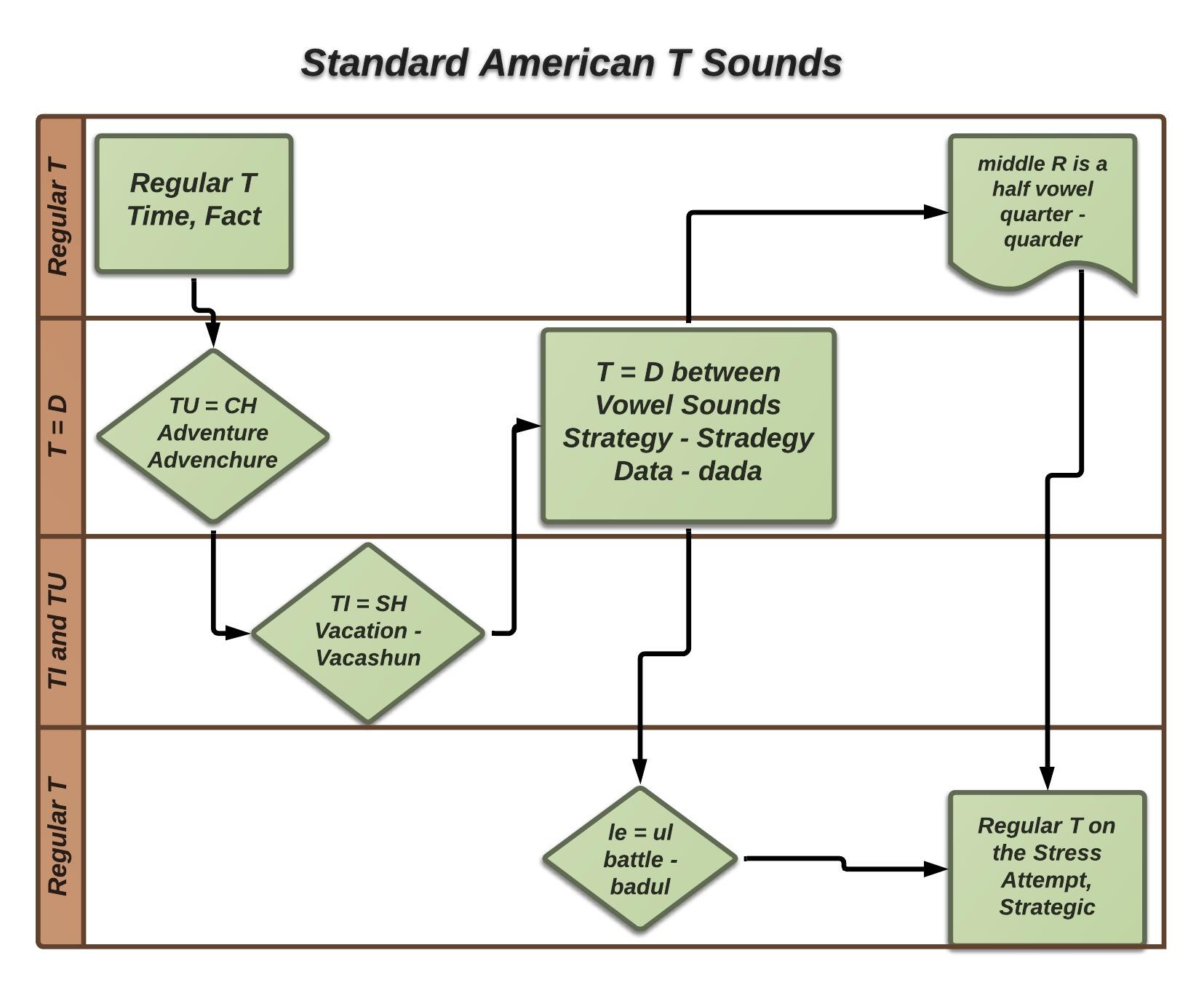 |
| The reduced T sounds are fundamental to the standard American accent. Because of the reduced T sounds and the large vowel sounds, American English sounds more flat and flowing than British English. In this lesson, none of the T sound changes are casual or optional. These are simply part of regular American English. |
| Explanation |
|
| Regular T | Use a regular T sound when T is the first letter as in table, test and tell. Use a regular T sound when T is next to a consonant as in st, ct and pt. Examples are stop, last, act, select, accept and apt. |
| TU = CH | In most words with a TU spelling in the middle (not at the beginning), the T becomes a CH sound, as in the word adventure. Also, DU follows this rule. The D becomes the slightly softer J sound, as in education. |
| TI = SH |
Similar to TU, TI often sounds like SH when it is in the middle or near the end of a word. You can see this rule in the ending -tion which sounds like shun. You can also see this rule in other words with TI such as initiate. |
| T = D between Vowel Sounds |
This is the most important T sound rule.
When T comes between two vowel sounds and it is not stressed, the T
becomes a D sound. This happens in many words such as water, strategy
and data. This rule also works in phrases with T as the last letter,
yet between vowel sounds, as in what if, put off, or at all. There are a few exceptions, like protein, protest and politics, but generally, this rule works very well. |
| T = D with L and R |
There are two additions to the T = D rule. The -le ending is an old spelling that actually sounds like ul. So the T = D rule works in words like settle and bottle. Also, we use a D sound in words like quarter, shorter and reported. Technically, a middle or final R is a half-vowel in American English. |
|
*Exception* |
Americans do not reduce the T if it is on the stress in multi-syllable words. Examples are: opportunity, attire, attempt, Italian, strategic, and politician. |
750 Business Words |
T Sounds Main Page |